Tree Cable and Bracing for Mature Canopies
Healthy old trees carry history in their bark. They also carry enormous loads. As canopies expand, the leverage on unions and laterals rises far faster than most homeowners realize. A sugar maple with a 60 foot spread can see thousands of pounds of dynamic force cycling through its scaffold branches in a winter wind. In wet snow or during summer thunderstorms, that load spikes. The result, if the structure is marginal, is a split crotch, a torn limb, or a trunk failure that unfolds in seconds and takes decades of growth with it.
Cable and bracing systems exist to bridge that gap between what the wood can safely hold and what the environment throws at it. Installed correctly, they are quiet partners, rarely noticed until the day they save a limb and the patio beneath it. Installed poorly or for the wrong tree, they become sharp metal embedded in wood that does little to reduce risk and a lot to complicate future pruning and removals. The difference is in assessment, materials, placement, and aftercare.
What cabling and bracing can and cannot do
Support systems do not make a weak tree strong. They reduce the likelihood of mechanical failure at specific points by redistributing load and limiting movement. Fixed steel cabling connects limbs to share forces across the canopy. Dynamic cabling uses synthetic rope to allow limited movement, which encourages adaptive growth and reduces shock loads. Bracing with threaded steel rods is used to repair or reinforce cracked unions and stems. In practice, we often design hybrid systems that combine a brace at a failing crotch with one or more cables higher in the crown.
There are jobs where support is an excellent option and jobs where it is the wrong answer. A mature beech with two co-dominant leaders and included bark may be a great candidate if the unions are still intact and the decay is minor. A silver maple with 40 percent trunk decay and active fungal conks at the root collar is not. In that case, no amount of wire and hardware will offset the loss of wood. Dangerous Tree Assessment and Removal, sometimes followed by Stump Removal & Grinding, is the safer path.
I have walked away from cabling several majestic but unsound cottonwoods over patios because the load path into the root system was already compromised by girdling roots and soil heave. The client was disappointed. Months later, one of those trees failed from the base during a storm. The remaining property damage was manageable because the tree had been removed. The decision looked conservative on the day we made it. It turned out prudent.
Reading the tree first: the role of a certified arborist
Every cabling job should start with a Certified Arborist Consultation. An arborist trained in risk assessment will review the canopy architecture, union angles, bark characteristics, and loading patterns in real time, not just from photographs. We probe for decay, sound out the trunk with a mallet, and may recommend advanced tools like a resistance drill or sonic tomography when the stakes and the tree size warrant it.
We also look at what the wind is doing around the site. Trees at the edge of a new subdivision or next to a recently cleared lot become wind loaders overnight. The same goes for trees left after partial removals. I once supported a veteran white oak that never needed help until its companions were removed during a redevelopment. The first spring, it started whipping in gusts like a flag. We installed two extra high strength steel cables at 70 percent of the branch height, then returned to prune for sail reduction. The oak is still standing, and its rings since then tell the story of added reaction wood.
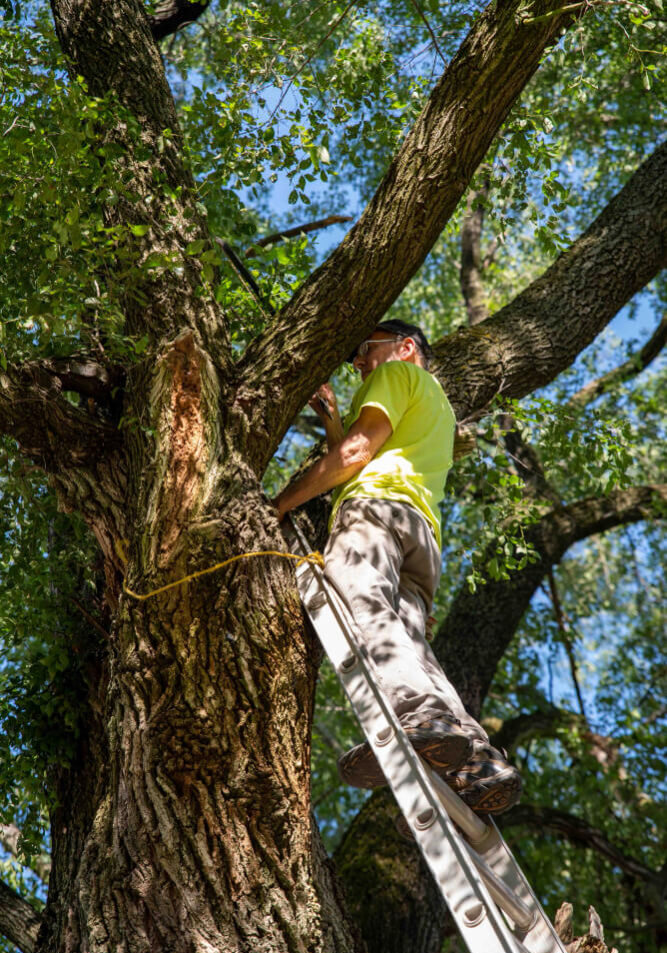
If your property has wildfire exposure, we layer in FireSmart Tree Services. This includes identifying ladder fuels, spacing canopies, and cleaning up duff and debris. A tree that is structurally supported but draped in deadwood and understory brush is a hazard in a different season.
Common candidates for support
Not every species responds the same way. Broadly, we see recurring patterns across urban and rural sites.
Elms and maples develop co-dominant leaders with included bark that peel apart under load. Birches and willows have heavy, https://donovanruio145.bearsfanteamshop.com/comprehensive-tree-removal-services-and-debris-hauling cantilevered laterals that reach over driveways and water features. Cedars and other conifers can split where multiple stems originate close to the ground, and they collect snow like gutters. Fruit trees carry remarkable fruit loads every few years and then nothing, a cycle that exerts uneven strain on scaffold attachments.
Signals that a tree may benefit from cabling typically show up before the crack. You may see long, parallel bark seams at a union, small specks of sawdust or frass where insects exploit a microfracture, or a faint creak in steady wind. Fresh, bright wood visible in a crotch where bark used to meet is a late sign. When we pick up on those early signals, we have more options and better outcomes.
Here is a concise, owner-facing checklist I often share during site walks.
- Two main stems of similar size rising from one point with bark squeezed inward at the crotch
- A heavy lateral over a target such as a roof, play area, or service line, with minimal opposite counterbalance
- Historic pruning that left a cluster of long, upright shoots where a scaffold used to be
- Multiple trunks splaying at the base with snow load history or visible lean
- Hairline cracks, fresh sap flow, or audible ticking in steady wind
If you see two or more of these conditions in a mature canopy, book an assessment rather than waiting for storm season. Emergency Tree Services exist for a reason, but emergency is the most expensive, disruptive, and risky way to find out how a tree is built.
Hardware, materials, and why they matter
A support system is only as reliable as its parts and the wood around them. In the fixed cabling world, we use extra high strength galvanized steel strand, commonly 7-strand, terminated with dead-end grips or eye splices and secured with thimbles in lag-eye or through-eye hardware. The decision between lag and through-bolt is a judgment call based on wood quality and expected forces. For large, sound limbs, through-bolts spread load across more fibers and are easier to inspect. In brittle or decayed wood, a lag may hold poorly and accelerate failure.
Synthetic, dynamic cabling systems use UV-stable, braided rope anchored around limbs with protective sleeves. They are forgiving in setup, reduce drilling, and allow a small range of motion that encourages the tree to lay down reaction wood. They also stretch, degrade in sun over many years, and require more frequent inspection and eventual replacement. I favor them for younger or moderately sized limbs where we want the tree to adjust and for species that respond well to dynamic movement, like lindens or hornbeams.
Bracing rods are different. When a union has cracked or when we know the growth habit will continue to pry two stems apart, we drill through both members and connect them with one or more threaded steel rods, washers, and nuts. The spacing matters. Rods too close to the crack act like single points of failure. Rods set in a staggered pattern above and below the plane of the crack spread the load and prevent rotation. We avoid bracing into decayed sections, since metal cannot anchor securely in punky wood.
Corrosion protection is not a small detail. Galvanized hardware holds up for decades in most settings. In salt-spray coastal sites and near winter-maintained roads, we adjust to resistive alloys or commit to more frequent replacement. I have replaced hardware on seaside oaks at 12 year intervals where inland jobs of similar size have gone 20 years before first replacement.
Placing cables in the crown
The old rule of thumb that still works: set cables roughly two thirds of the distance from the union to the tips of the limbs you are supporting. The reason is leverage. Forces increase as you approach the end of the lever arm. By placing the cable out in the upper crown, we reduce movement where it matters most and give the wood closer to the union a fighting chance.
We seldom install a single straight line. Triangulated systems are stronger and more stable, especially in wind that changes direction. On a three-stemmed red oak, that means linking each pair of leaders so forces distribute around the triangle. On two-stem systems, we may tie both stems to a dominant, centered leader if the geometry allows. The goal is to support without creating new stress points or sawing the cable across bark in motion. That is why we use thimbles and sleeves and why we isolate cable from bark everywhere it could touch.
Heights, distances from the union, and hardware angles go into a job record along with photos and torque specs. Five or ten years later, no one remembers precisely where a bolt sits inside a swelling collar unless you wrote it down.
Integrating pruning with support
Tree Pruning & Crown Shaping goes hand in hand with cabling. We reduce end weight beyond the cable and thin selectively to drop sail where wind hits hardest. This is not a race to the center of the tree. Over-thinning creates lion’s tales that whip and snap. The right approach targets redundant laterals competing for the same space, reduces codominants that can be subordinated, and removes deadwood that would tear in high winds and damage the cable or bark.
On a mature sycamore we cabled over a playground, we combined a two-cable system with a 12 to 15 percent reduction on the most exposed laterals. That small percentage made a measurable difference in deflection during wind events, visible even to the owner who watched from the kitchen window. The canopy looked natural, not clipped. The union that worried us developed stronger collars over three growth seasons, which we confirmed on inspection.
Fruit trees follow different rules. Supports there may be seasonal, such as temporary props during heavy crops. Structural cabling on apples and pears is uncommon, but not unheard of when scaffold angles are poor from past training. In those rare cases, we keep cable diameters small, prioritize dynamic systems, and combine with winter pruning that rebalances the load.
Protocol for inspection, maintenance, and replacement
A support system buys time, it does not eliminate the need for eyes on the tree. Growth swallows hardware. Bark thickens around lags and through-bolts. Limbs that were light at installation can double their mass in a decade. A quiet failure is possible if no one looks up.
For owners and property managers who like practical steps, here is a simple schedule that keeps most supported trees in their safety window.
- First inspection after the first significant wind or snow event, then again at one year to retension and document growth response
- Every two to three years afterward, a Certified Arborist Consultation to check hardware, cable tension, and wood condition
- After any major storm event on site, a spot check for frayed rope, loose thimbles, or hardware movement
- Replacement planning at 12 to 15 years for synthetic systems, 15 to 25 years for steel cables depending on environment
- Pruning every three to five years to maintain load balance and clear deadwood before it tests the hardware
If you prefer to set reminders, tie them to local seasons. In snow country, check before the first heavy storm warnings. In hurricane belts, book an inspection in late spring. In fire-prone areas, pair the visit with FireSmart work in late winter.
Safety, access, and site logistics
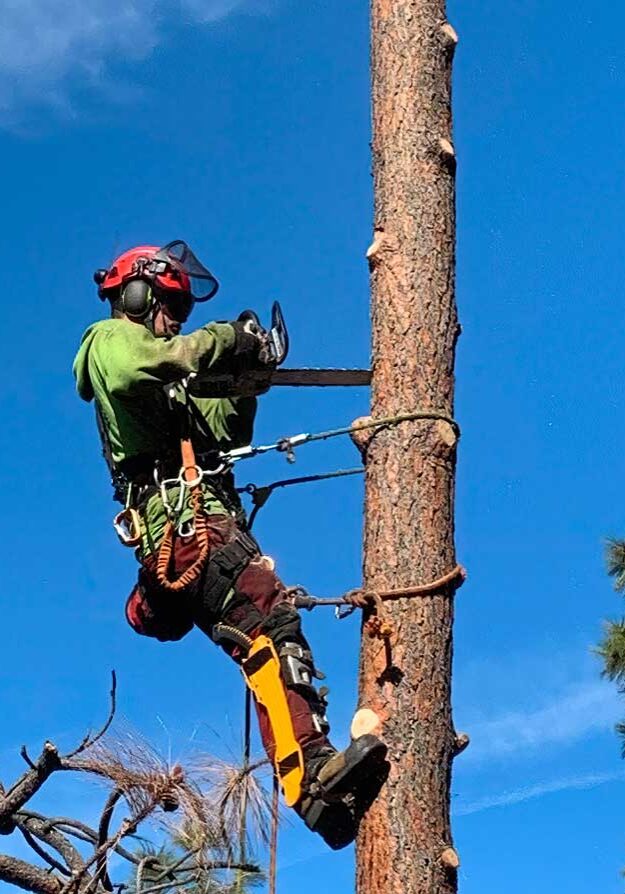
Most cabling requires climbing into the upper third of the canopy. On tall trees, that means rope access or aerial lift work. The work involves drilling, working with tensioned cables, and carrying heavy hardware aloft. Setup time often exceeds time aloft. We tape bark to avoid scarring where we brace a drill, and we use rope friction savers to protect cambium when we climb.
When we cannot reach with a bucket, we rig. In tight backyards, rigging lines may extend over roofs or out to anchors in adjacent trees. We plan line paths so that if a tool slips, it falls into a safe zone, not into a barbecue or a skylight. Homeowners often ask why we are fussing with cones and taped-off walkways for what they thought was a quick job. The answer is that we want the focus aloft, not on people or dogs walking under a limb where a drill is running at shoulder height.
If your tree is over a service drop, coordination with the utility reduces risk. Cabling near energized lines is not casual work. We schedule line covers or a temporary shutdown. That takes extra time on the calendar. It is cheaper than a trip to the hospital or a neighborhood blackout.
Cost ranges and how decisions get priced
Costs vary with height, access, number of cables or braces, and the time it takes to set lines safely. A straightforward two-cable installation in a 40 foot maple in a flat front yard with easy truck access may land in the low four figures. Add a brace rod, a third cable, and tight rear-yard access through a gate, and the price climbs. Synthetic systems can be faster to install where drilling is risky or where we are working high in flexible wood, which can reduce labor. They carry higher replacement frequency. Steel systems cost a bit more up front when we add braces and through-bolts, but they often run longer between replacements.
Beware of bargain quotes that ignore inspection and maintenance. Any legitimate plan will include a schedule. If someone quotes you half the market and hands you no record, assume you are buying a one-time install that no one plans to see again until it breaks.
When support is not enough
Some trees are structurally past the point where support is defensible. Extensive decay in the trunk or buttress roots, active basal fungi like Ganoderma with conks large enough to hold rainwater, and soil movement on the windward side that indicates root plate instability are red flags. In these cases, Dangerous Tree Assessment and Removal protects people and structures. You free up funds for replanting rather than sinking money into a short-lived scaffold.
Emergency Tree Services come into play when a tree has partially failed. In that moment, do not attempt DIY bracing. A cracked fork can shift silently and drop hundreds of pounds without warning. A trained crew can stabilize, reduce immediate load, and either proceed with controlled removal or return later for planned support and pruning if the assessment says the tree can be saved.
When removal is unavoidable, a good company will discuss Stump Removal & Grinding so the site can be restored and replanted. They will also walk you through species choices that fit the site and reduce the chance that you are in the same spot again in thirty years. A well-placed young tree with sound training is a better inheritance than a compromised veteran over the bedroom.
Permit considerations and neighborhood dynamics
Some municipalities require permits for hardware installed in protected trees. Heritage or street trees may fall under urban forest bylaws that treat cabling like pruning, removal, or construction. Check before work starts. In neighborhoods with shared canopy over property lines, it helps to brief the neighbor. A simple note that we are installing Tree Cable and Bracing to support a shared limb avoids surprise when they see a climber across the fence with a drill. Good fences do not fix tree disputes. Good communication does.
Case notes from the field
A landmark silver maple over a historic porch had two codominant leaders with pronounced included bark. The owner loved the canopy and was understandably anxious. Decay testing showed intact wood at the union edges but a soft center, about 10 to 15 percent of cross section. We braced the union with two rods staggered above and below the fault line and installed three fixed steel cables in a triangle at about 65 percent of height. We pruned lightly for reduction beyond the cables. Five years later, the union has added substantial reaction wood. Inspections showed steady, even callus growth around hardware. The porch remains in shade, and the owner has a written plan for eventual cable replacement around year 18 if corrosion or growth dictates.
A wind-exposed Douglas fir at the edge of a new clearing began to sway dramatically after neighboring removals. The main concern was a heavy side limb over a pool. We opted for a dynamic synthetic cable from that limb to the central leader, set high and protected with sleeves. We combined it with selective thinning on the windward side. The system reduced exaggerated motion without freezing the tree in place. Two seasons later, growth rings near the union are thicker, and the cable shows no UV damage. We have it on a two year inspection schedule because conifers grow fast in that site and hardware placement needs to be adjusted as the limb extends.
A multi-stemmed birch with decay at the base and lean toward a driveway presented as a borderline case. We refused cabling because the load path through the root plate was already compromised. The client appreciated the candor and chose Tree Removal Services. We ground the stump, amended the compacted soil, and planted a tupelo in its place. The new tree will not threaten the drive in their lifetime and needs no hardware to stand well if trained from year one.
How support fits into a broader care plan
Cabling is not a standalone service. It is a tool within an arboricultural program that might also include Tree Pruning & Crown Shaping, soil improvement, pest and disease monitoring, and fire risk mitigation. Trees with support systems deserve a spot in your property maintenance budget alongside roof inspections and furnace service. The payoff is measured in avoided damage, preserved shade, and the simple pleasure of living under a canopy that has been cared for with intention.
If you have a tree that worries you, start with a Certified Arborist Consultation. Ask for a clear explanation of the defect, photos or diagrams of the proposed system, the materials, and a written inspection timeline. If the assessment instead points toward Dangerous Tree Assessment and Removal, expect an honest discussion about targets, felling strategy, and what Stump Removal & Grinding will involve. If the site needs quick response because a limb has already failed, call for Emergency Tree Services and keep people and pets away until a crew arrives.
Trees that reach maturity give more than they take. When they need a little engineering to continue doing that safely, well-designed Tree Cable and Bracing systems are worth every hour and every bolt. The work is precise. The decisions are grounded in wood science and experience. The outcome, when done right, is a stronger relationship between people and the canopy that shelters them.
Ace Tree Services Ltd.
Name: Ace Tree Services Ltd.Address: 4656 Wallace Hill Road, Kelowna, BC
Postal code: V1W 4C2
Phone: 250-212-9593
Website: https://acetree.ca/
Hours:
Monday: 7:00 AM - 5:00 PM
Tuesday: 7:00 AM - 5:00 PM
Wednesday: 7:00 AM - 5:00 PM
Thursday: 7:00 AM - 5:00 PM
Friday: 7:00 AM - 5:00 PM
Saturday: 7:00 AM - 5:00 PM
Sunday: Closed
Open-location code (plus code): RHF8+8G Kelowna, British Columbia, Canada
Map/listing URL: https://www.google.com/maps/place/Ace+Tree+Services+Ltd./@49.8232606,-119.4337283,659m/data=!3m2!1e3!4b1!4m6!3m5!1s0x537d8b1d074815c5:0x450b88afa7a41435!8m2!3d49.8232606!4d-119.4337283!16s%2Fg%2F11ydkpnh22
Embed iframe:
Ace Tree Services Ltd. provides professional tree removal, pruning, stump grinding, emergency response, and arborist consultations for properties in Kelowna and across the Okanagan Valley.
The company works with homes, commercial properties, and municipal settings where tree work needs to be planned carefully around buildings, fences, driveways, landscaping, and other site constraints.
Based in Kelowna, the team is positioned to help nearby neighbourhoods and surrounding Okanagan communities with routine tree care and time-sensitive storm cleanup.
Customers looking for careful tree work often want a crew with certified arborist training, insurance, and a methodical approach to higher-risk removals.
Services also include dangerous tree assessment, cabling and bracing, and wildfire risk reduction tree work for properties that need longer-term planning.
To request a quote or discuss tree care options, call 250-212-9593 or visit https://acetree.ca/.
A public map listing is available to help customers confirm the business location and get directions before a site visit or estimate.
For Kelowna property owners who need pruning, removals, or emergency tree help, a local tree service can make it easier to schedule site-specific recommendations and cleanup.
Popular Questions About Ace Tree Services Ltd.
What services does Ace Tree Services Ltd. provide?Ace Tree Services Ltd. lists tree removal, stump removal and grinding, tree pruning and crown shaping, emergency tree service, arborist consultation, dangerous tree assessment and removal, cabling and bracing, and wildfire risk reduction tree work.
Who does Ace Tree Services Ltd. serve?
The company describes its work as serving homes, businesses, and municipalities in Kelowna and across the Okanagan Valley.
Is emergency tree help available?
Yes. Emergency service is listed for downed or uprooted trees, dangerous tree assessment, stabilization work, and branch cleanup. If a tree is near power lines, the safest first step is to stay clear and contact the utility provider before any tree work begins.
Do I always need a permit to remove a tree?
Not always. Permit requirements can depend on where the tree is located and whether it is near a creek, lake, steep slope, or another protected area. It is best to check local rules for the specific property before removal work starts.
How deep does stump grinding usually go?
Standard stump grinding is typically described as going about 6 to 12 inches below ground level, which is often enough for grass or surface landscaping. Deeper grinding may be possible when site plans call for it.
How much of a tree can be safely removed at one time?
That depends on the species, age, health, and structure of the tree. In practice, good pruning is usually about removing the right limbs for health, clearance, and structure rather than chasing a fixed percentage.
What are common signs that a tree may be dangerous?
Large dead limbs, visible cracks, a new lean, root damage, canopy dieback, or storm-related damage can all be warning signs. Trees near structures deserve extra attention when any of those issues appear.
What is cabling and bracing in tree care?
Cabling and bracing are support systems used to reduce the risk of failure in trees with structural weaknesses that may still be worth preserving. They are generally used to add support, not to replace good assessment and ongoing maintenance.
How do I contact Ace Tree Services Ltd.?
Call 250-212-9593.Website: https://acetree.ca/.
Landmarks Near Kelowna, BC
Downtown KelownaThe downtown core is a practical reference point for lakefront neighbourhoods, mixed-use streets, and central residential properties. If your property is near downtown, tree pruning, removals, and cleanup can be planned around tighter access and nearby structures.
Knox Mountain Park
This well-known park north of downtown is a recognizable landmark for nearby homes and hillside properties. If you are close to this area, ask about tree assessment, trimming, or removal work suited to sloped sites.
Mission Creek Greenway
The greenway runs through several parts of Kelowna and is a useful landmark for nearby residential areas. If your property borders or sits near this corridor, site-specific tree planning is especially important.
Pandosy Village
Pandosy is one of Kelowna’s most recognizable neighbourhoods and a common reference point for south-central properties. If you are nearby, request help for pruning, removals, or storm cleanup around homes and small commercial sites.
Rutland
Rutland is a major east Kelowna neighbourhood with a mix of residential and local commercial properties. If you are located in or near Rutland, tree work can be scheduled for both routine maintenance and urgent situations.
Landmark District
This central business-focused area is a practical landmark for offices, service properties, and nearby residential streets. If your site is near the district, ask about careful tree work around parking, access lanes, and built-up lots.
Kelowna’s North End
The North End sits on the edge of downtown and is a useful reference for nearby homes, industrial sites, and commercial properties. If you are in this part of the city, request tree care based on the layout and constraints of the lot.
Airport District
The Airport District is a recognizable north Kelowna reference point for surrounding properties and access routes. If you are in this area, ask about tree services for residential acreage, commercial sites, or roadside cleanup needs.
Glenmore & Dilworth
These established Kelowna neighbourhoods are useful landmarks for central and north-central service calls. If your property is nearby, pruning and removal work can be tailored to mature trees and established landscapes.
Highway 97 Corridor
Highway 97 is one of the city’s main travel routes and a common way to describe location within Kelowna. If your home or property is just off the corridor, a clear landmark reference can help speed up quote scheduling and site planning.